Conflict of Interest: Why Advisor Alignment Matters More Than Ever in Lease Negotiations
Cresa is built for occupiers, which provides both clarity of focus and conflict-free partnership.
Understanding the Risks of Dual-Agency Representation
The practice of brokers serving both landlords and tenants is common, despite the conflict of interest created when the tenant’s needs and the broker’s incentives are incompatible – often the case in dual-agency situations. Landlords, to whom the broker has a fiduciary obligation, want the highest rates and the fewest concessions. Conversely, tenants would like the lowest rates and the best concessions. Something must give, and the advantage typically goes to the landlord.
The simple reality is that brokers who represent both tenants and landlords can’t be fully objective. Brokers have an obligation to bring tenants to their company’s listings. Given the opportunity to steer a tenant toward their own company’s listing or toward a competitor’s, which is more likely to be their choice? This arrangement is clearly not in the tenant’s best interests.
Follow the money, and you’ll see that the battle for a dual agency broker’s attention is no contest. Based on the public filings of large, full-service commercial real estate firms, approximately 80-90% of their revenue comes from representing landlords through leasing, property management, or investment sales.
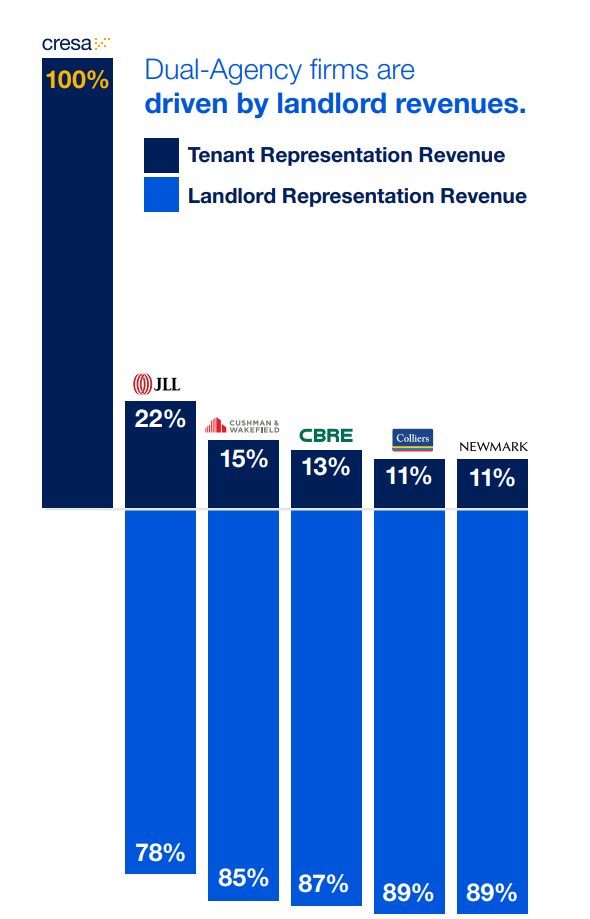
It is telling that the industry’s largest dual agency firms offer standard conflict of interest disclaimers in their public filings. One company reported that its diverse business lines and broad client base subject it to “numerous potential, actual or perceived conflicts of interest, ”while another notes that conflicts can occur when “the primary duty of loyalty we owe to one client may potentially be weakened or compromised by a relationship we also maintain with another client or third party.”
As the challenges to dual agencies grow (several high-profile lawsuits have been filed over the past few years), the practice is questioned more frequently. CFOs who would not accept this conflict with other service providers are scrutinizing their company’s real estate decisions, performing greater due diligence in examining their outsourcing relationships and focusing on the bottom-line implications of such potential conflicts.
A Tenant’s Checklist for Advisor Transparency
To ensure alignment with a commercial real estate advisor’s interests, companies should ask the following questions:
1. What is the advisor’s track record with similar clients and transactions?
Get references and recommendations. Research the track record of the broker on similar deals. Have conflicts arisen before? Do their tenant clients believe they got their money’s worth? Did they return the next time they needed help?
2. Does the advisor or firm represent landlords?
Tenants should raise the issue of potential conflicts early in the relationship. This includes asking whether the firm represents landlords, manages properties, holds current listings or has asset/property management agreements with companies that could sit on the other side of the negotiating table.
3. How will confidential information be protected?
In a data-driven market, tenants should understand how their rental rates, lease information, renewal timing, occupancy costs, expansion or contraction plans, workforce strategy and other sensitive business information will be collected, stored, shared and protected.
4. How are fees, commissions, or incentives structured?
Insist on full disclosure. Ask for an accounting of the fees or commissions that landlords are paying them, as well as bonuses or discounts.
5. How does the advisor create leverage?
A strong advisor should be able to explain how they will compare alternatives, create competitive tension, pressure-test landlord proposals and negotiate terms that support the tenant’s business goals.
The Data Usage and Protection Issue
As commercial real estate becomes more data-driven, the handling of market information has become a critical tenant issue. For tenants, the concern is twofold: whether market data is used to help them negotiate better outcomes, and whether their own confidential business and real estate information is protected. Tenant information can be highly sensitive. Rental rates, renewal timing, expansion or contraction plans, workforce strategy and location preferences can all be used to weaken a tenant’s leverage before negotiations even begin.
That’s why data usage and protection must be part of the conversation around advisor alignment. A tenant’s advisor should be transparent about what information is used, how it informs recommendations and how confidential client data is collected, stored, shared and protected.
When used responsibly, data can create meaningful leverage. It allows occupiers to create competitive tension between viable options. The value comes not from the data alone, but from applying that information strategically and in the tenant’s best interest.
Our technology platform Cresa Core supports this approach by helping occupiers connect real estate data, portfolio insights, and decision-making tools in one platform with enterprise-grade controls that protect client data and keep it governed end-to-end.
In a data-driven market, protecting tenant information and using that data to better their position are critical factors in the advisor relationship.
Conclusion
In lease negotiations, tenants need to know the information guiding their decisions is used responsibly, confidential business data is protected and their advisor’s recommendations are fully aligned with their goals.
As market data, technology and analytics continue to play a larger role in commercial real estate, advisor alignment becomes even more important. Tenants should have confidence that their advisor is interpreting information through an occupier-first lens and using it to create leverage, improve outcomes and support long-term business objectives.
Cresa’s conflict-free model is built around a simple principle. Because we do not represent landlords, our advisors sit on one side of the table: the occupier’s. That structure helps eliminate a common concern and allows us to focus on what matters most, helping tenants make informed decisions and achieve the best possible outcomes.
Related